Home Page
Narratives
Improbability Driving in Dundee
Looking for White Van Man
Strange tales from the Kingsway
Legal Notes
A Kangaroo in the Court Room
Working to Procure Injustice
Fighting Injustice
Open Letters
Updates
Lex, Lies, (no Videotape)
Other Info
Criminal biographies
The Cost of Injustice
|
|
Appeals
"A proportion of those who have been convicted will continue to protest their innocence, but verdicts have
historically been treated as final, and despite the establishment of appeal courts and ..... independent criminal case review
commissions, it remains very difficult for those who have been found guilty to have their convictions quashed."
Prof P Ferguson, Chair of Scots Law at Dundee University: Would you like to plead 'not guilty'? Or 'actually innocent'? - from an
abstract in Law School News, June 2016
"For the criminal justice system to prioritise justice rather than its own ideological interests
it needs to function not on finality ... but on the uncertainty principle."
Dennis Eady, Miscarriages of Justice: The Uncertainty Principle, PhD Thesis, Cardiff University, July 2009
"If you are innocent in this country, you have got serious problems, because we do not have
safeguards in place to prevent miscarriages of justice."
Mark McDonald KC, quoted in The Guardian 22 November 2023
Contents
1 - 1st Extension of Time application
2 - Scottish Criminal Cases Refuse Commission - 1st application
3 - Scottish Criminal Cases Refuse Commission - 2nd application
4 - The European Court of Human Rights appeal
5 - 2nd Extension of Time application
6 - Notes
Italicised text (on occasions enclosed by quotation marks) is used for quotations.
Text that is either underlined or in bold font, is the author’s emphasis.
1 - 1st Extension of Time application
A couple of days after the trial, my partner and I went to see Crookswank to discuss my Appeal.
"Now what are your grounds for appeal?" he enquired.
I said I thought that was his job. He said I had No Grounds for Appeal, parroting
his old babble:
"You are guilty of Careless Driving on your own admission. I'm an advanced driver. I used to race cars although I don't hurry now.
I've been a PF. If I'd been on the Bench I'd have found you guilty."
In Scotland you can only Appeal on a point of law by saying, in effect, that the Sheriff has got it legally wrong.
Solicitors aren't keen on doing that, particularly when there is no transcript of the trial to refer to.
This did not stop Crookswank from picking up the phone and calling the Legal Aid Board to cover the cost of the interview.
The usual string of personal anecdotes followed, before we got down to discussing an appeal against the sentence alone.
He said he did not advise it, because the appeal judge could increase the sentence or even reinstate the original charge.
This sounded like blackmail.
I said:
"I'll take that risk".
He said:
"It would be very foolish. I do not advise it".
I said:
"I'll take that risk".
He said:
"I do not advise it".
Instead of 'marking' an Appeal, he sought Counsel's Opinion. Counsel is an advocate who inhabits the
appeal courts in Edinburgh and knows how the judges think.
The Opinion delivered by the Advocate, Moira C. MacKenzie, matched
Crookswank's view.
This was not altogether surprising, since she would only have received his version of events.
The slogan of Moira C MacKenzie's chambers goes like this:
REMEMBER WE ARE HERE TO HELP YOU.
So I sent her a polite letter that asked if she'd had access to the Sheriff's Notes
before drafting her Opinion.
I wanted to know if she had relied solely upon what Crookswank had told her.
I was, in effect, questioning her Opinion.
Back came a snotty letter from her chambers rebuking me, a mere member of the public, for contacting an Advocate
in a way that is not permitted.
I learned later that the smart way to proceed is to put in an Appeal, no matter how groundless.
The Sheriff then has to give the reasons for his verdict, upon which a more informed judgement can be made as to
whether to continue or abandon the Appeal.
65% of appeals are abandoned, either by appellants or as a result of a three-phase filtering process called the SIFT.
Of those that do get through only 7% are successful. In only a tiny proportion is the sentence increased.
It began to dawn on me that the Scottish Justice System actively discourages appeals.
In particular, it will not allow appeals against a sheriff's judgement unless there has been an error in law:
you cannot challenge a sheriff's interpretation of the evidence, no matter how off the wall it might be.
This is unfair because sheriffs are not infallible. They are just as capable of faulty reasoning or
using their gut feeling in place of objective analysis as any ordinary member of the public.
A judge is supposed to look for corroboration of what a witness says. This will usually be provided by other witnesses,
unless persuasive documentary evidence has been presented to the court.
In my case Sheriff McCulloch would have compared the three witness testimonies looking for correspondences and
inconsistencies.
He would have used his years of experience to assess the witnesses, taking into account their body language and
tone of voice as well as what was actually said, thereby forming an impression of their credibility.
But what the three witnesses said (given in detail here) was riddled with inconsistencies and
improbable events.
With one exception, McCulloch failed to spot them.
He found the Crown's witnesses to be reliable and credible.
Why?
Well, although judges are supposed to be wary of playing the witness numbers game, the key
factor in convincing McCulloch of the credibility of the Crown's witnesses was obviously the fact that there were
three of them, all telling a similar story.
Against only one Defendant.
Being able to challenge a judicial decision based on flawed evidence that may not have been rigorously examined is,
I believe, a fundamental right.
I intended to make every effort to exercise it.
Since Crookswank was refusing to take further instructions, I tried to get a second opinion.
Ian Woodward-Nutt was my prospective solicitor. He wanted to know who had been acting for me.
When I mentioned Crookswank's name, Woodward-Nutt said,
"I'm sorry I can't help you" and abruptly put the phone down.
So I filled in a form I obtained from the Court and made the Appeal myself, sending it to the original Court in Dundee.
The reply said I was Out of Time (you only get 7 days to mark an appeal).
Months later, having worked hard to build up a case, I submitted an application for an
Extension of Time in which to appeal.
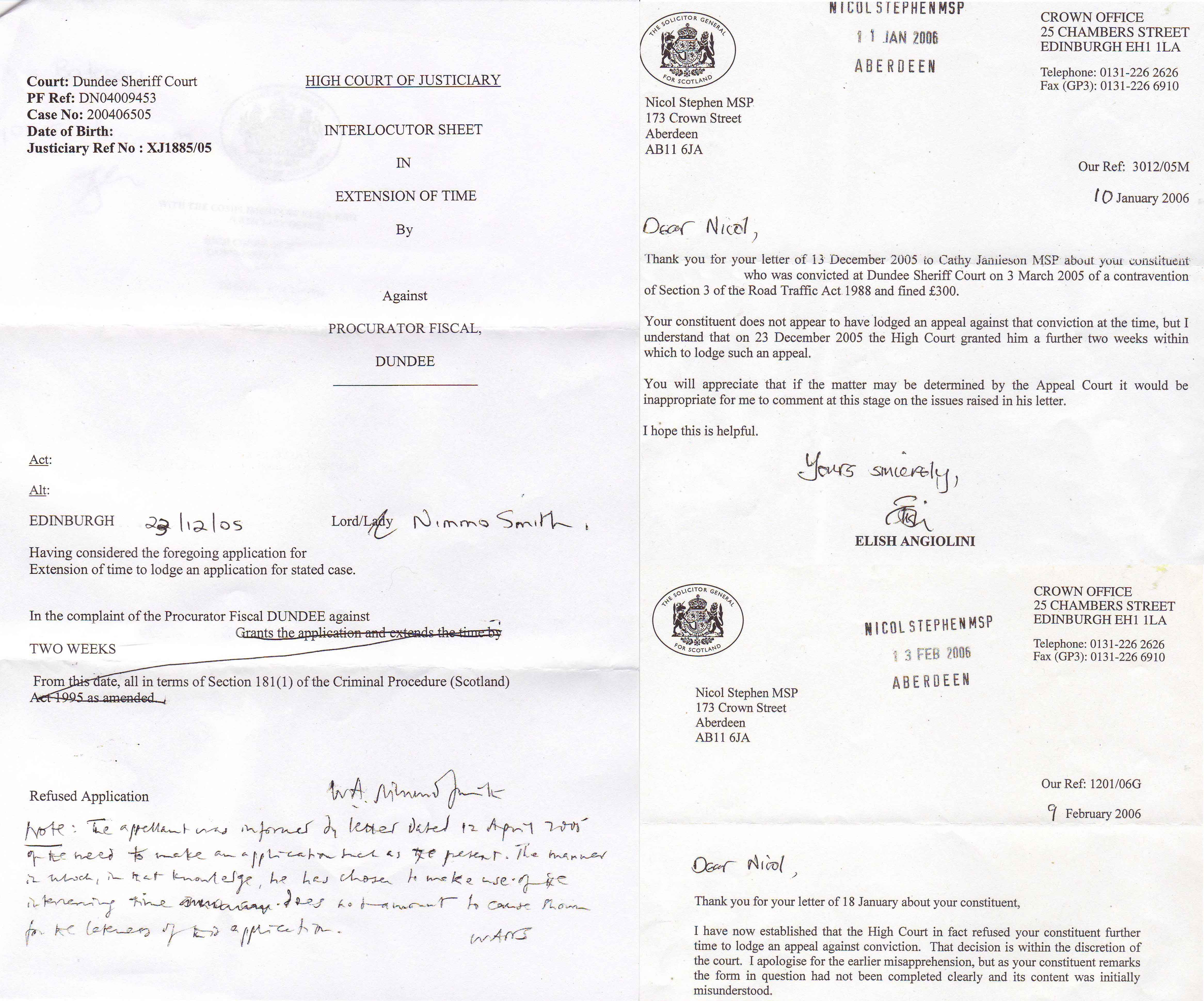
Back came the response, delivered by a Lord Nimmo Smith, on a single page entitled Interlocutor Sheet in
Extension of Time. The irrelevant parts of the form had been hastily scratched out and the esteemed Lord's
reason for refusing my application scribbled at the bottom.
It so confused Elish Angiolini, the Solicitor General, that in a letter to my MSP, she stated that I had
actually been granted leave to appeal.
When I wrote to Angiolini to correct her faulty impression, I remarked that the Interlocutor Sheet had "evidently been written by a man for whom a fine lunch beckoned".
Had I known then that Nimmo Smith is a Munroist (Number 641 on the List), who is halfway through climbing all of
Scotland's 3000ft hills for the 2nd time, I might have added that he was probably far too busy working out his
average time per mountain to be bothered with a trivial case like mine.
Angiolini apologised, saying Nimmo Smith's Interlocutor Sheet had not been completed correctly and its content was
initially misunderstood.
The Interlocutor Sheet and Solicitor General's correspondence can be viewed
here.
2 - Scottish Criminal Cases Refuse Commission
Introduction
The SCCRC (which, with no hint of irony, actually calls itself the Scottish Criminal Cases
Review Commission) looked at my evidence
and dismissed it, giving muddled reasons, or sometimes no reasons, for so doing.
In particular, it concluded that even though the Crown's 3 witnesses might have made identical errors
when giving the location and timing of a crucial item of evidence - the broken-down van - their credibility was not undermined and
there was no suggestion that they were lying.
I felt the Commission might have added a disclaimer: No flying pigs were harmed in the making of this conclusion.
To be fair to the SCCRC, it is obliged to apply the same tests as the Appeal Court when determining if a conviction is safe or not.
Unfortunately, those tests follow traditional pathways bound by arcane legal processes that do not always involve common sense.
Partial independence
It is worth noting that the SCCRC was set up as an independent body to investigate judicial decisions that
may turn out to be miscarriages of justice.
There are four reasons to doubt its independence:
First, the SCCRC's use of legal terms (eg: 'as spoken to by the witnesses';
'the vehicle libelled in the charge'; 'evidence was led by the Crown') strongly suggests that its loyalties
lie with the Justice System and not with the applicants, its clients.
Second, as noted above, the test for referring cases to the Appeal Court is flawed.
Third, its chief executive, Gerard Sinclair, is also a sheriff, a man who makes judicial decisions.
Fourth, Michael Hanlon, my Case Officer, is on secondment to the SCCRC from the Crown Office,
the organisation that prosecuted and convicted me.
The English have the same problem. There, the Law Commission has recently said that the referral test
used by the CCRC encourages it “to be too deferential to the court of appeal and to seek to second-guess what
the court might decide, rather than reaching an independent judgment of whether there may have been a
miscarriage of justice”.
My impression of the SCCRC is that it lived up to its 'independent' label only by keeping me,
the applicant, at a safe distance with its cold, pedantic eye.
I expect it has a more collaborative relationship with its friends and colleagues in the legal brotherhood.
Details - 2006 application
[Text from the SCCRC's report is in italics.]
[A statistical analysis of the part of the SCCRC's caseload that concerns driving offences can be found at
the bottom of the page.]
I had always heard of this body in the context of serious cases like murder and rape,
rather than motoring misdemeanours.
I looked it up on the web and it seemed fairly user-friendly. There was an application form, so I filled it in,
taking care to present my arguments in detail and with as much clarity as I could manage.
Unfortunately, I wasn't aware then that the Commission only speaks legalese: I was told later that DIY applications are
only half as likely to get to the Appeal Court as those made by solicitors.
And less than 6% of all the applications received by the SCCRC are referred to the Appeal Court.
Still, I was pleased that the Commission took on my case, given the absence of court records.
It wrote to my former solicitor, to the Sheriff, to the Procurator Fiscal and to the Clerk of the Court
for information, some of which was disclosed to me when it gave its opinion 9 months later.
Their accounts of the proceedings in court that day must have matched my own account pretty closely because the SCCRC
had nothing critical to say about it.
Without the SCCRC, I would never have known what the Sheriff thought, or that my solicitor had dropped me in the shit,
or that before the trial, one of the charges had been dropped and others amended.
The Commission made a show of examining my case in considerable detail, so much so that I think it could not see the wood
for the legal trees: it was so concerned with legal technicalities that it failed to spot the improbable flavour of the Crown's evidence.
Of course, at the time of application, I had little in the way of hard evidence to present to the Commission, and it responded predictably enough.
Here is an example:
The Commission considers … that there is no way of knowing whether the Crown witnesses
conspired to falsify the allegations made against him.
The Commission considers these submissions to be entirely without foundation.
The police were not under a duty to investigate the independence of the witnesses in the applicant's case,
where there was no reason to doubt same.
The adversarial nature of the criminal justice system in Scotland means that it was open to the applicant
to instruct his solicitors to carry out investigations in this regard,
and to present this as a line of defence at trial.
However, the applicant has presented no evidence upon which to base his claims in relation to this matter and
there is no reason to believe that this would have been a persuasive argument if presented in his defence.
There is a hint here of an implicit recognition by the Commission that prosecution testimonies will always be believed and never need checking,
while those of defendants are worthless, so will not be investigated.
It also fits rather neatly with the Crown's position (given to me by a court official) that
it is up to defendants to prove their innocence.
In order to prove my innocence I did try to carry out the investigations suggested by the Commission:
1) I asked my un-cooperative solicitor to do it. He refused.
Yet he was within his rights - Scottish solicitors are not legally obliged to carry out client instructions,
a fact the SCCRC conveniently ignored.
2) Then, after the trial, I tried to carry out investigations myself, mainly by writing to associates of the witnesses, whose details I got
from the internet.
My activities resulted in a visit from the local constabulary, accusing me of a Breach of the Peace:
I was asked (but declined) to accept a Caution.
It's a neat little Catch 22 that deters defendants from looking for evidence that might exonerate them.
My main arguments were founded on the suspect dock identification process and on the Crown's failure to disclose the evidence of the white van.
This is what the Commission had to say on the latter:
The Commission notes that the applicant is correct in his assertion that the statements of Crown witnesses
were not made available to his solicitors prior to his trial.
Reassuringly, it added:
Nevertheless, the Commission notes that it has subsequently been established that not all failures to disclose relevant information
will result in a miscarriage of justice.
Shortly before it was due to issue its Report, I sent the SCCRC Tayside Police's
Incident Log
- the one that gave the location of the van the witnesses had mentioned in their evidence.
I submitted that since the broken-down van appeared to have been logged at a point 1.5 kilometres from the alleged incident,
the 'witnesses' must have been lying.
The Commission did not see it this way, however: its assessment of this piece of evidence generated a mass of verbiage,
dressed up to resemble analytical rigour.
Its reasons for rejecting my submission are hard to fathom.
This pararaph is how the SCCRC summarised its position:
15. The information provided by the applicant suggests that there was a van broken down
40 minutes after, and some distance from, the incident which was described by the witnesses for the Crown. It is not clear to the
Commission why this would suggest that the witnesses were lying in describing the incident which they spoke to in evidence. The
information does not clearly undermine the witnesses' reliability, as it does not provide proof that they lied about what they saw earlier
in the day. Nor would it have been likely to have had a material bearing on their reliability, as it was not in dispute that the
witnesses were travelling eastbound, and it is therefore unlikely that any suggestion that they may have made a mistake about what
they saw on the basis of this report would have been successful.
In trying to understand what the report writer meant, I present this phrase-by-phrase analysis:
The information provided by the applicant ....
Well, the 'information' (an Incident Log plus an Inspector’s remarks about its contents) was actually 'provided by' Tayside Police.
An impeccable source, which may be why the SCCRC grudgingly accepted it as fact.
The information ... suggests that there was a van broken down 40 minutes after, and some distance from, the incident which
was described by the witnesses for the Crown.
Writing 'some distance from', when "about a mile and a half from" would have been accurate and more informative,
is a mealy-mouthed way of trivialising
the difference between what actually happened and what the Crown claimed to have happened.
The information ... does not provide proof that they lied about what they saw earlier in the day.
If it was not proof of lying, then what? A form of collective
confabulation, perhaps, with all three 'witnesses' trapped by a false memory?
The information does not clearly undermine the witnesses' reliability ...
Whether lies, confabulation or mere errors of recollection, dodgy evidence from three different
'witnesses' would surely raise questions in the mind of any rational person.
Nor would it have been likely to have had a material bearing on their reliability, as it was not in dispute that the witnesses
were travelling eastbound ...
So, even though the three witnesses might have made identical mistakes, their reliability
was not in doubt
because they were travelling eastbound.
It would, it seems to me, have made just as much sense had the reporter written: "... their reliability was not in dispute because
they had Coco Pops for breakfast".
Such other-worldly logic allowed the Commission to conclude that it was not minded to refer my case to the High Court.
'not minded to', meaning 'not inclined to', hints at a decision that is not set in stone, but is open to debate;
it suggests an organisation with a human face, a mind, as in open-minded.
But, given its low pass rate, it seems likely that the SCCRC put my application on the
Reject pile early in the
process, which I imagine went something like this:
* Collecting responses from the court attendees: a few months perhaps.
* Finalising the Report, with its Statement of Reasons: ready after 5 or 6 months.
* Dealing with my late submission of the Police Incident Log: the SCCRC was faced either with doing
a full investigation or scratching around for reasons to reject the Log out of hand.
It chose the latter, without bothering to ask Tayside Police for detailed information or comments.
* Six weeks later, having slapped on its hastily concocted reasons for dismissing my new evidence,
the SCCRC was able to issue its final Report.
The entire process took 8 months.
Details - 2020 application
While drifting in the doldrums of the 2020 pandemic, I decided to make another application to the
Scottish Criminal Cases Refuse Commission.
It was only semi-serious because I knew there was little chance of success. As an organisation that has plainly been set
up to prevent appellants from appealing - the figures speak for themselves: only 5% of all applications are referred to
the Court of Appeal - the SCCRC is truly taking the piss. As such I felt it was a legitimate target for satire: I hoped
to poke the monster to see what kind of stuffed shirt reaction I got.
So I made a second application to have the judgement (or part of it) referred.
I wanted to have the conviction for allegedly swerving in front of the motorcycle to avoid a lorry set aside.
My grounds for appeal?
Well, there was no independent corroboration of the alleged incident, because Roman's sole 'witness' was his
girlfriend, Jessica.
The application process is more streamlined than in 2006 and it took only 40 minutes to accomplish using an
online form that I had to post to Glasgow.
I reckoned my application would be rejected just as soon as it was read, followed by a collective head scratching to find
a plausible reason for turning it down.
So I wasn't a bit surprised when the rejection came through a mere couple of months later.
But I was surprised at the reason given.
The Commission wrote that the law does not require witnesses to be 'independent'.
In support of its assertion it referred me to Renton & Brown's 'Criminal Procedure', which states that
"the fact that the offence was committed and that it was committed by the accused, must be established by
evidence from at least two sources".
The SCCRC pointed out that "No reference is made to 'independence'",
noting that 'independence' is not a legal requirement.
I knew nothing of this when I made my application: Renton and Brown is not available in my local library
and although a copy can be readily purchased, it would have set me back £1400.
I'd based my application on the following:
1) a definition of corroboration from a Glossary of Legal Terms published by the Crown Office & COPFS, which does use the term 'independent':
"An accused cannot be convicted unless there is evidence from at least two independent sources that the crime was
committed and that the accused was responsible for it".
2) the SCCRC's very own definition of corroboration, given in its 2006 Statement of Reasons for
rejecting my first application:
"The criminal justice system in Scotland only requires evidence from two independent sources to
corroborate a case and convict an accused".
Most legal commentators think that sources of corroboration should be 'independent'.
I have posted a couple of their definitions in the Notes below.
As far as Renton & Brown is concerned, my view is that their omission of the word 'independent',
does not mean that it can be excluded from the requirement.
The SCCRC, I suspect, cherry-picked the Renton & Brown definition because it seemed to support its argument
against my application.
Then, knowing it was vulnerable to criticism on this point, it decided to attack me because I may have
"misunderstood its position as set out in the October 2006 statement of reasons".
The SCCRC continued:
"The aforementioned reference to "independent sources" could have been phrased "separate sources" as may properly be
implied by the reference to "three such sources"".
Silly me - I should have realised that "independent sources" really means "separate sources".
You couldn't make it up. But the SCCRC just did.
Comedy Gold!
3 - The European Court of Human Rights
In March 2007 I grappled with the bilingual form used by the European Court of Human Rights for appeals.
I saw that the rules state that applications have to be within 6 months of the final decision by a domestic court.
The High Court's peremptory rejection of my attempt to appeal had taken place some 13 months earlier, with the intervening time
taken up by the SCCRC's deliberations. I hoped that the Europeans would consider the SCCRC to be part of the domestic
appeal process.
It took them 2 years to get to the point of considering my appeal.
At that point, some frog-faced functionary dismissed it using the injustice system's favourite get-out clause:
"Out of Time".
4 - 2nd Extension of Time application
In November 2009 I re-submitted my application to the High Court in Edinburgh for an Extension of Time.
To my great surprise, the new application was accepted for consideration, though the judge,
Lady Paton, "refused the prayer".
She did hint that she might be prepared to reconsider if she had a sight of various documents, including the Police Incident Log
and the SCCRC decision.
So, ever anxious to keep my Lords and Ladies busy, I sent off a wad of paperwork.
This time the rejection took over two weeks to arrive, suggesting that Lady Paton, unlike Lord Nimmo Smith, had at least read
through all the documentation.
Click to see the Interlocutor Sheet
page 1 and
page 2.
This, effectively, was my Appeal, though one put before a judge sitting alone without any verbal submissions.
It was rejected, but at least I'd managed to get it heard.
5 - Notes
Statistical footnote
The following information has been gleaned from the Commission's website and from a FOI request.
Thanks to the SCCRC Legal Officer, David Fitzpatrick, for being so helpful.
This is the (edited) correspondence about my
WhatDoTheyKnow style FOI request.
As the Commission's published statistics do not distinguish between types of crime or sentence,
the figures given should be regarded as approximations.
In the 20 years following its inception in 1999, the SCCRC has dealt with around 106 applicants trying to challenge their
convictions or sentences for driving offences.
A 25% rate of repeat applications means that 130 to 135 applications were actually made.
Of these, 17% received custodial sentences, mainly for Dangerous Driving cases, of which slightly more than half involved deaths.
The Commission has no information to offer on a further 13% of these applications.
A majority of the applications, 60%, were for convictions for minor driving offences, including faulty or missing documentation,
speeding, using a mobile phone and Careless Driving.
Only 3% of all the applications made to the Commission result in successful appeals.
Corroboration definitions
Fraser Davidson and Pamela Ferguson, both Professors of Law at Scottish universities, write:
"..at present Scottish law retains a corroboration rule. This requires the 'facts in issue' to be proved by
two independent sources of evidence. Thus the prosecution must establish: (1) that the crime was committed,
and (2) that the accused was the person who committed it, and must (generally) provide two independent sources
of evidence for each of these."
(emphasis mine)
[see Davidson, F. P. & Ferguson, P. R. (2014): the corroboration requirement in Scottish criminal
trials: should it be retained for some forms of problematic evidence? in International Journal of Evidence and Proof, 18(1), 1-27.
https://doi.org/10.1350/ijep.2014.18.1.439]
This is the Law Society of Scotland's definition of corroboration, given on its website:
"The requirement under Scots criminal law is that the essential facts of a case be proven by corroborated evidence,
that is, evidence from two independent sources."
|
|